Aachen
Aachen sits at Germany's western edge, tucked against the borders of the Netherlands and Belgium. It is a historic city known above all for one building — its cathedral — and for its connection to Charlemagne, who made the city his capital and was buried here. Charlemagne, crowned Holy Roman Emperor, arrived in 768 and spent most of his final years in Aachen. He ordered the cathedral built, and the core of that structure still stands today.
copy.webp)
Aachen Cathedral
The Aachen Cathedral (Aachener Dom) is the oldest cathedral in northern Europe and was the first German site inscribed on the UNESCO World Heritage List. When the initial list of twelve sites was published in 1978, the cathedral was among them. Construction began around 796 under Charlemagne, and the Palatine Chapel at its core remains the best-preserved example of Carolingian architecture.
The cathedral combines two building periods and two architectural styles. The original early-ninth-century core is the octagonal Palatine Chapel, supported by eight large columns with smaller chapels arranged around it. This early Byzantine style drew on churches in Ravenna and Constantinople. When built, the chapel's width and height made it the largest domed structure north of the Alps, and it held that distinction until the great Gothic cathedrals of the later Middle Ages. The Gothic choir was added later, extending the building with pointed arches, external buttresses, and more than 1,000 square meters of stained glass, modeled on the Sainte-Chapelle in Paris.
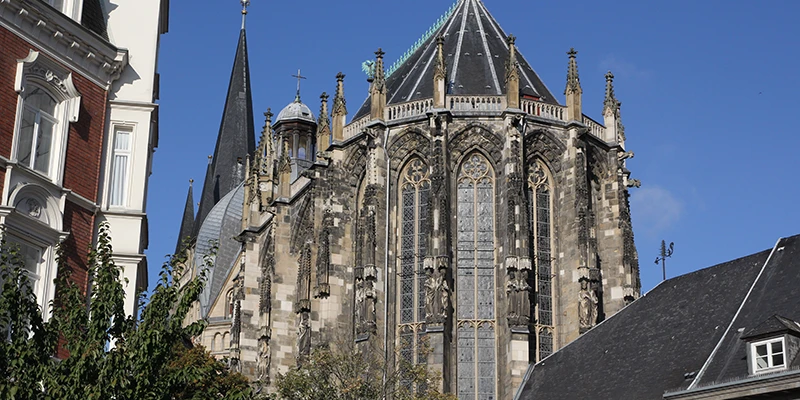
The cathedral served as the coronation church for thirty German kings between 936 and 1531. Charlemagne's throne, constructed from marble slabs, still stands in the upper gallery where newly crowned kings were seated. Charlemagne himself is buried here in a golden reliquary coffin placed in a position of honor within the Gothic choir, beneath the vaulting arches and stained glass.
The interior rewards slow exploration. Visitors benefit from walking to several positions within the chapel to take in different angles, then sitting to absorb the space. Photographs convey only a partial sense of the building's scale and decoration.
The Pedestrian Zone
The cathedral stands at the center of Aachen's pedestrian zone, as is typical of medieval town plans. The zone is compact — roughly 400 meters across — and easily covered on foot in a couple of hours. No cars are permitted, though cyclists are common, some with cargo bikes carrying substantial loads.
.webp)
The lanes around the cathedral are lined with shops, outdoor restaurants, and cafés. The pace is unhurried, and locals use the area for strolling as much as for errands. A visit of two to three hours suits most travelers, combining a meal, a short round of shopping, and time inside the cathedral and Rathaus.
The Marktplatz
The Marktplatz, Aachen's historic market square, sits a short walk from the cathedral and opens directly onto the Rathaus. The square hosts a produce market with stalls selling fruit, vegetables, flowers, bread, and regional specialties. Standup food carts offer inexpensive meals — a bratwurst with fries runs under five euros and remains a staple of the lunchtime crowd.
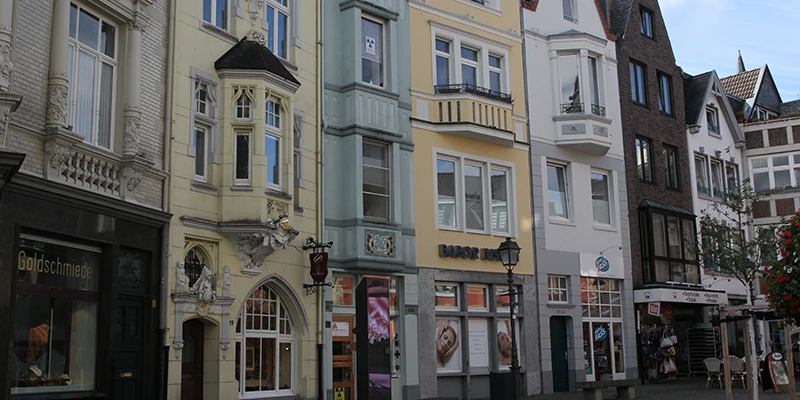
At the center of the square stands the Karlsbrunnen, a 17th-century fountain topped with a bronze statue of Charlemagne and the oldest surviving monument to the emperor in the city. Historic four- and five-story townhouses with steep roofs and colorful facades frame the square on all sides, and their ground floors house cafés, bakeries, and small restaurants whose outdoor tables spill across the pavement in warm weather. The square functions as Aachen's main gathering place and is a natural spot for a lunch break before entering the Rathaus.
City Hall (Rathaus)
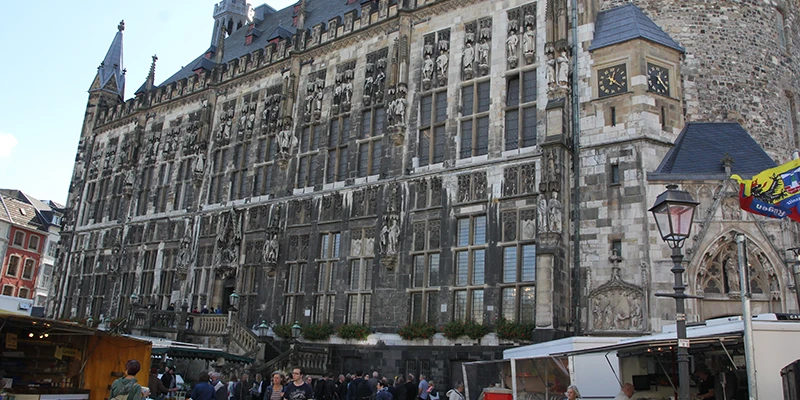
The large historic building on the north side of the market square is the Rathaus, Aachen's City Hall, built between 1330 and 1380 on the foundations of Charlemagne's palace. Fifty statues of German kings line its facade. The building is open to the public as a museum for a small admission fee.
The principal interior space is the Coronation Hall (Kaisersaal), where banquets were held after royal coronations in the cathedral. It runs 45 meters — the full length of the building. The hall contains replicas of the Imperial Regalia and 19th-century frescoes depicting scenes from Charlemagne's life. The Rathaus has been rebuilt and altered repeatedly across its 650-year history, including substantial damage during the Second World War, though little of that is visible in its current appearance.
Elisengarten
.webp)
A short walk from the cathedral and the Marktplatz brings visitors to the Elisengarten, a small formal park that serves as the pedestrian zone's main piece of green space. The park dates to the early 19th century and sits directly behind the Elisenbrunnen pavilion, the two sharing a name and a neoclassical heritage. Lawns, gravel paths, and mature trees frame benches that fill up on warm afternoons with office workers on lunch breaks, parents with small children, and travelers resting between sights. A glass pavilion at the park's center protects an archaeological window showing Roman and medieval foundations uncovered on the site. The Elisengarten is Aachen's natural pause point — unhurried, shaded, and a few steps from everything in the old town.
Thermal Springs and the Elisenbrunnen
.webp)
Aachen's thermal springs have been used since Roman times — the city's name derives from a word meaning water, and the Romans established baths here in the first century. The Elisenbrunnen, a neoclassical pavilion near the pedestrian zone, provides public access to the sulfurous mineral water, which emerges at high temperature and carries a strong distinctive smell. The water is drunk for purported health benefits, and modern spa facilities at the Carolus Thermen on the edge of the old town continue the bathing tradition.
copy.webp)
Practical Information
Aachen is a straightforward day trip from several directions. Trains from Cologne take about 50 minutes, from Brussels about 1.5 hours, and from Maastricht about 45 minutes. The compact pedestrian zone means a visit can be completed in half a day, though travelers who want to tour the cathedral treasury, the Rathaus interior, and spend unhurried time in a café will want a full day.
The cathedral itself is free to enter, but photography requires a small fee, and access to specific areas — including Charlemagne's throne in the upper gallery — is available only by guided tour, which should be booked in advance during peak season. The Cathedral Treasury (Domschatzkammer), adjacent to the cathedral, holds one of the most important collections of medieval ecclesiastical art in northern Europe and charges a separate admission.
.webp)
Aachen's local specialty is Printen, a hard spiced gingerbread flavored with anise, cinnamon, and candied fruit or nuts, sold in numerous shops around the old town. It keeps well and is a common gift purchase for visitors heading home. The city's position at the meeting point of Germany, Belgium, and the Netherlands also makes it a practical stopover on routes between the Ruhr, the Benelux countries, and northern France.
The Official Tourist Information website has more information about the city and surroundings.
.webp)
.webp)