Vienna Day Three: Belvedere, Hofburg, and Beyond
.webp)
Day Three covers Vienna's remaining major attractions: the Belvedere with Klimt's The Kiss, the vast Hofburg Palace complex, the contemporary art museums of the MuseumsQuartier, the eccentric Hundertwasserhaus, and an evening ride on the Riesenrad Ferris wheel in the Prater.
Upper Belvedere
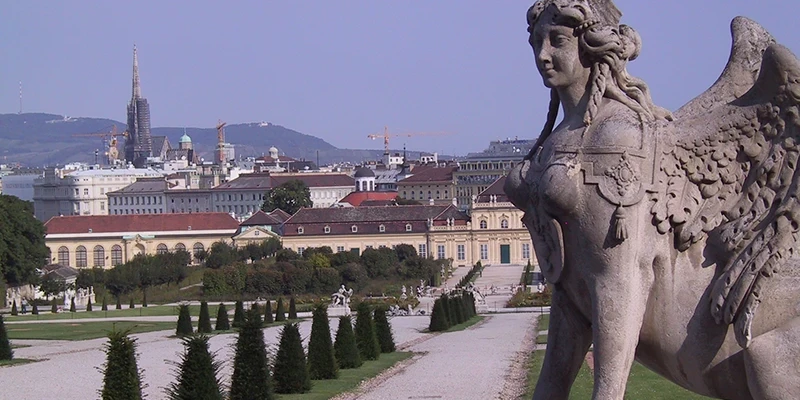
Begin the morning at the Upper Belvedere, a Baroque palace built by Lukas von Hildebrandt between 1714 and 1723 for Prince Eugene of Savoy — the military commander who saved Vienna from the Ottoman siege. The palace now houses the Austrian Gallery, with the world's largest collection of Gustav Klimt paintings, including The Kiss, Judith, and Portrait of Adele Bloch-Bauer I (the "Woman in Gold").
copy.webp)
The collection extends beyond Klimt to other Vienna Secession artists — Egon Schiele, Oskar Kokoschka — and to French Impressionists including Monet, Renoir, and Van Gogh. The palace interiors are themselves worth seeing: the Marble Hall, with its ceiling fresco and views across the gardens, was where the Austrian State Treaty was signed in 1955, ending the post-war occupation.
The formal gardens between the Upper and Lower Belvedere descend in terraces adorned with fountains, statues, and clipped hedges. Walk through to the Lower Belvedere, which served as Prince Eugene's summer residence and now hosts temporary exhibitions. The Orangery between them holds additional gallery space.
Hofburg Palace
(02)copy.webp)
From the Belvedere, take tram D toward the Ringstrasse, alighting at the Burgring stop for the Hofburg — the immense imperial palace that served as the Habsburg seat of power for over 600 years. The complex expanded over centuries into a city within a city, with 18 wings, 19 courtyards, and 2,600 rooms. Today it houses the Austrian president's offices, several major museums, the Spanish Riding School, the Vienna Boys' Choir chapel, and the National Library.
copy.webp)
Enter from Michaelerplatz through the Michaelertor, the grand entrance portal, and cross the In der Burg courtyard to reach the Imperial Apartments — the private rooms of Emperor Franz Joseph and Empress Elisabeth (Sisi). The Sisi Museum in the same wing tells the story of the empress's life, from her unhappy marriage to her assassination in Geneva. The Imperial Silver Collection displays the tableware used at state banquets.
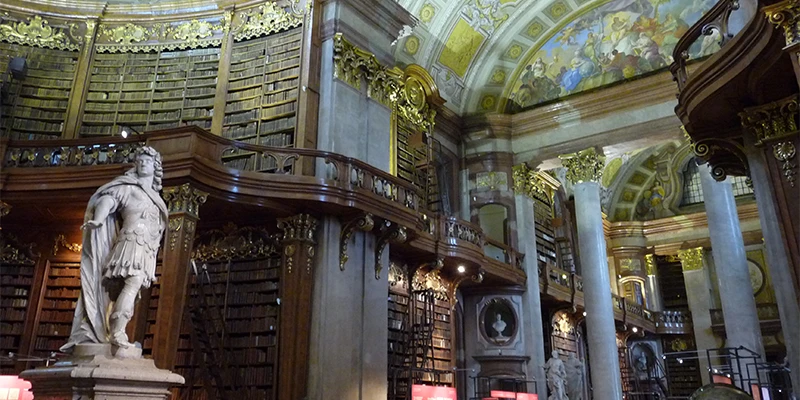
The Austrian National Library's State Hall is one of the world's most beautiful library interiors — a Baroque masterpiece completed in 1735, with ceiling frescoes by Daniel Gran, marble columns, and 200,000 historic books. Admission is separate from the Imperial Apartments.
(02)copy.webp)
Other Hofburg attractions include the Treasury (Schatzkammer), with the crown jewels of the Holy Roman Empire and the Imperial Crown of Austria; the Hofburgkapelle, where the Vienna Boys' Choir sings Sunday Mass (arrive early for seats); and the Spanish Riding School, where Lipizzaner horses perform classical dressage in a Baroque riding hall. Morning training sessions are open to visitors without advance booking.
MuseumsQuartier
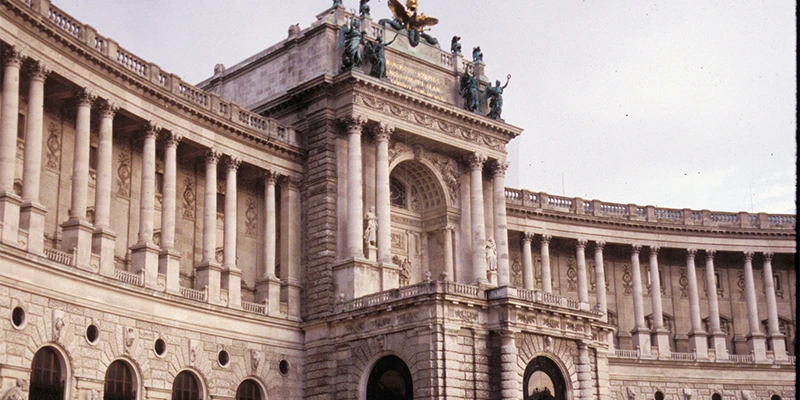
Exit the Hofburg through the Heldenplatz, the vast ceremonial square flanked by the curved Neue Burg wing, and cross the Ringstrasse to the MuseumsQuartier — one of the world's largest cultural complexes, built within the former imperial stables. The MQ, as locals call it, combines Baroque architecture with bold contemporary additions by Ortner & Ortner architects.
(02)copy.webp)
The Leopold Museum holds the world's largest Egon Schiele collection, along with Klimt, Kokoschka, and the Vienna Secession. MUMOK (Museum of Modern Art) covers 20th and 21st-century art from Picasso and Warhol to contemporary installations. The Kunsthalle hosts changing exhibitions. The central courtyard, filled with brightly colored "Enzis" loungers in summer, is a gathering spot for students and locals.
Behind the MQ, the Spittelberg quarter preserves a grid of Biedermeier houses now filled with cafés, boutiques, and galleries. The narrow lanes come alive on weekend evenings and host one of Vienna's prettiest Christmas markets in December.
Hundertwasserhaus and KunstHausWien
.webp)
For something completely different, take tram 1 to the Hundertwasserhaus in the third district — a municipal housing block designed by artist Friedensreich Hundertwasser. Completed in 1985, the building rejects straight lines in favor of curves, uneven floors, and façades bursting with color, ceramics, and vegetation. Trees grow from balconies and rooftops. No two windows are alike. The building is residential and not open to visitors, but a small shopping village across the street gives a sense of Hundertwasser's style.
Two blocks away, the KunstHausWien museum occupies a former furniture factory redesigned by Hundertwasser. It holds a permanent exhibition of his paintings, graphics, and architectural models, plus rotating exhibitions of photography and contemporary art. The museum café and garden are worth a stop.
The Prater and Riesenrad
.webp)
End the day at the Prater, Vienna's traditional amusement park, where the Riesenrad (Giant Ferris Wheel) has been a landmark since 1897. One of the oldest surviving Ferris wheels in the world, it featured in The Third Man's famous zither-scored scene between Orson Welles and Joseph Cotten. The ten-minute ride offers panoramic views over Vienna, best at sunset when the city lights begin to glow.
.webp)
The Prater beyond the Ferris wheel includes a full amusement park with roller coasters, carousels, and carnival games — somewhat kitschy but authentically Viennese. The Hauptallee, a straight four-mile avenue through the park's green space, is popular with joggers, cyclists, and families. Restaurants and beer gardens line the park entrances.
If time permits, the Prater is also home to the Ernst-Happel-Stadion, Vienna's largest sports venue, and the Planetarium. But for most visitors, the Riesenrad at sunset, followed by dinner at one of the traditional beer halls or a final concert in the old town, makes a fitting end to three days in Vienna.